Unifying CRM and MarTech into one seamless flow

Unifying CRM and MarTech into one seamless flow

Unifying CRM and MarTech into one seamless flow

Bridged clunky post-merger integrations between efficy's CRM (Maxo) and MarTech (Apsis). Eliminated delays and mismatched UX, delivering a prototype by end-2024 for end-to-end email campaigns in one unified system.

Keep scrolling for the story or, go straight to the solution.

Bridged clunky post-merger integrations between efficy's CRM (Maxo) and MarTech (Apsis). Eliminated delays and mismatched UX, delivering a prototype by end-2024 for end-to-end email campaigns in one unified system.

Keep scrolling for the story or, go straight to the solution.

Role

Led design from Maxo's side, partnering with Apsis's designer amid complex stakeholder dynamics. Coordinated with PM and dual engineering teams, aligning high-level owners from both products through multiple decision layers.

Led design from Maxo's side, partnering with Apsis's designer amid complex stakeholder dynamics. Coordinated with PM and dual engineering teams, aligning high-level owners from both products through multiple decision layers.

Time

August - December 2024

Impact

Delivered end-2024 MVP that secured Maxo's GTM with seamless CRM x MarTech flows.

Tags

Product design

UX design

Usability testing

Integration
Impact

Business

  • Secured Maxo GTM vs competitors

  • End-2024 MVP prototype shipped

  • Cut connector delays + data ingestion

User

  • Seamless CRM→MarTech flows

  • No tab-switching or manual setups

  • Intuitive campaign-first workflows

Design

  • Deep linking standards established

  • Terminology + design system unity

  • 4+ iterations + 10-user testing validated

Context

In 2024, Efficy's latest product Maxo was putting final touches on go-to-market.

However, one crucial feature was missing: built-in marketing capabilities that all Maxo’s main competitors offered—even in starter packages—with email marketing (automation, analytics, campaign management).


While none of Efficy’s CRM products had these native features, they could integrate with efficy’s fully developed MarTech platform, Apsis. Problem was, the connectors were slow, had long data ingestion times, and required complex, inconsistent, manual setups.

Problem

On top of the technical slowness and cumbersome setup, the existing connector suffered from zero unity.

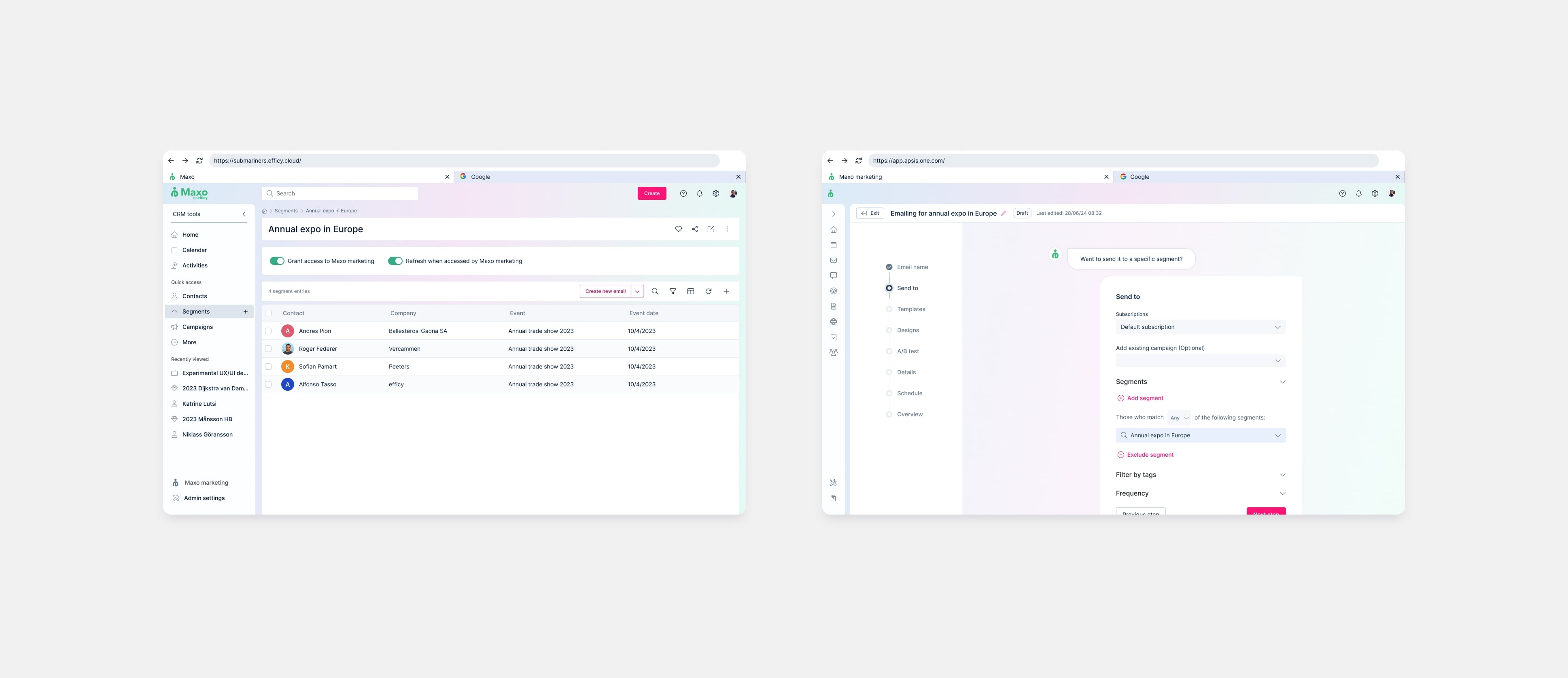
Users could peek at some information from MarTech in the CRM (and vice versa), but user flows were exclusive to one platform—meaning constant switching and waiting around.


Worse, the platforms looked and functioned completely differently, with massive inconsistencies in user flows, terminology, and branding.
Approach

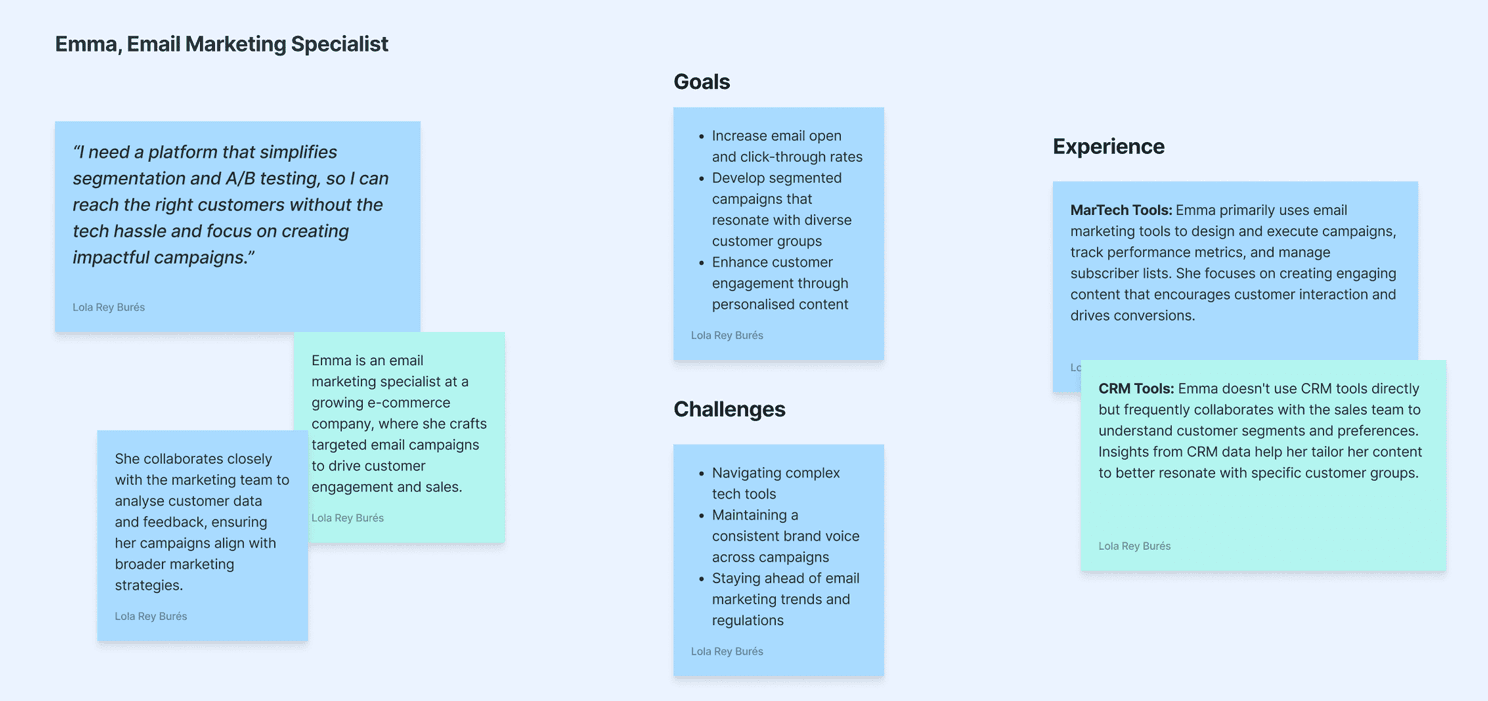
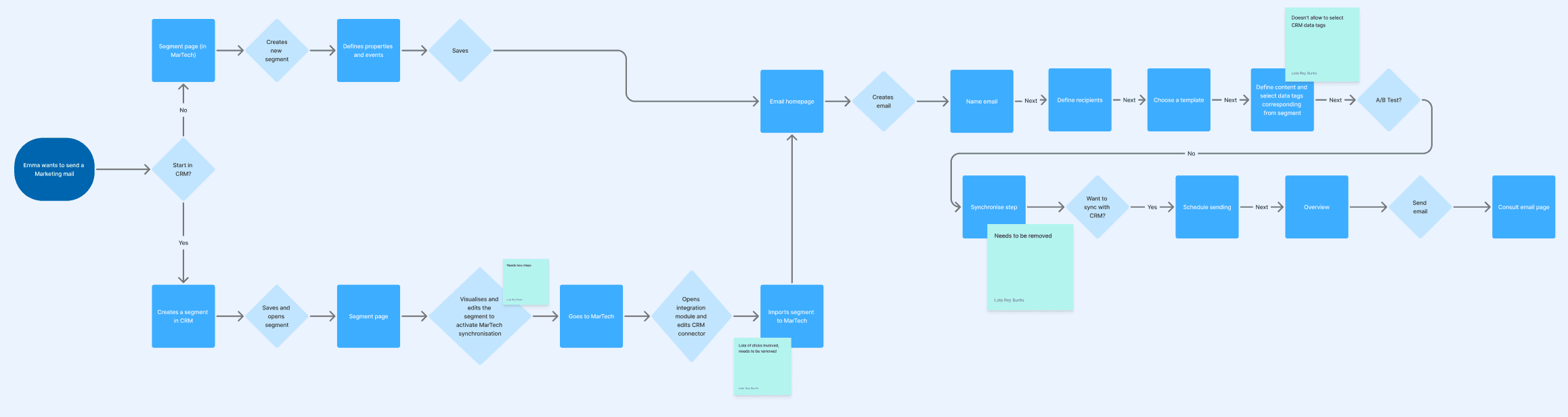
Since this feature had been simmering before I joined, I kicked off by reviewing all existing materials from the product manager. They'd already mapped user expectation gaps and defined our marketing personas and roles.
My main objective as designer: deliver a functional prototype to validate and test cross-product user flows. Scoped to end-of-year deadline constraints, it let us test if the functionality hit MVP value.


Deep linking was the biggest gap—both products lacked direct access points and shortcuts to each other.

We zeroed in on email sending for the MVP. (MarTech also does SMS, web forms, automation flows, but those were too ambitious for the deadline.

My main objective as designer: deliver a functional prototype to validate and test cross-product user flows. Scoped to end-of-year deadline constraints, it let us test if the functionality hit MVP value.


Deep linking was the biggest gap—both products lacked direct access points and shortcuts to each other.


We zeroed in on email sending for the MVP. (MarTech also does SMS, web forms, automation flows, but those were too ambitious for the deadline.

These materials help set the context for the project but were provided to me by my brilliant colleagues, who made them.

These materials help set the context for the project but were provided to me by my brilliant colleagues, who made them.

Prototype

I replicated Emma's exact user flow in the prototype, then refined it—setting browser tab rules and pinpointing deep link needs.
Teamed up with a MarTech designer to map two access point types:

  • Generic: Quick access to other platforms in the suite (beyond just Apsis). Opens in a new browser tab to preserve original context when journey isn't pre-set.

  • Specific: Journey-specific entry points like sending email from CRM campaign or email to CRM segment. Refreshes current page for seamless, interruption-free flow.

I went through 4+ rounds of prototype iterations to align team + stakeholders on behavior and tech feasibility. Meanwhile, both products hit rebranding which meant constantly updating UI, design systems, and visual unity, adding serious iteration complexity.

Teamed up with a MarTech designer to map two access point types:

  • Generic: Quick access to other platforms in the suite (beyond just Apsis). Opens in a new browser tab to preserve original context when journey isn't pre-set.

  • Specific: Journey-specific entry points like sending email from CRM campaign or email to CRM segment. Refreshes current page for seamless, interruption-free flow.


I went through 4+ rounds of prototype iterations to align team + stakeholders on behavior and tech feasibility. Meanwhile, both products hit rebranding which meant constantly updating UI, design systems, and visual unity, adding serious iteration complexity.

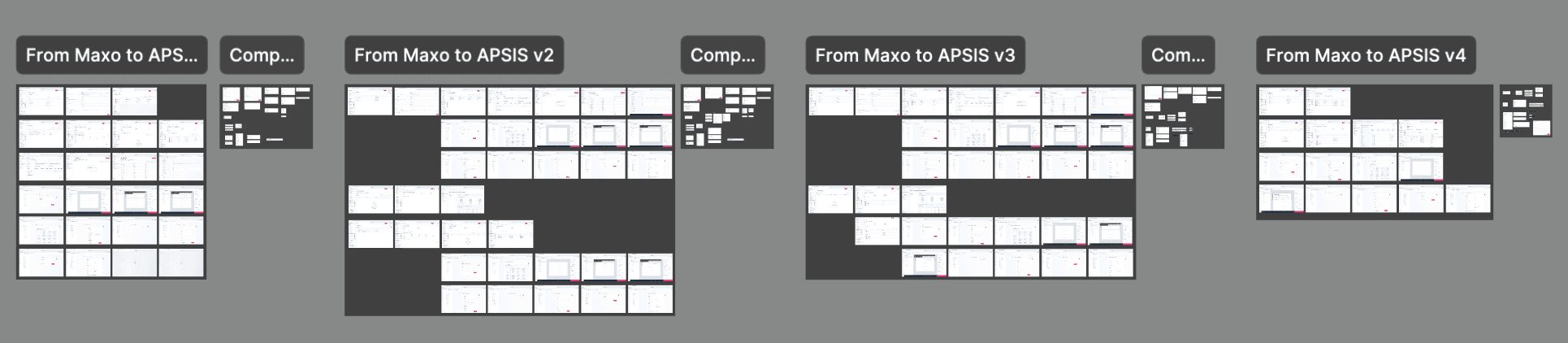
A look at all the different prototypes, iterated on weekly

A look at all the different prototypes, iterated on weekly

Usability testing

Ran two rounds of usability testing: first with 5 internal Efficy users, second with 5 external users matching our future customers.
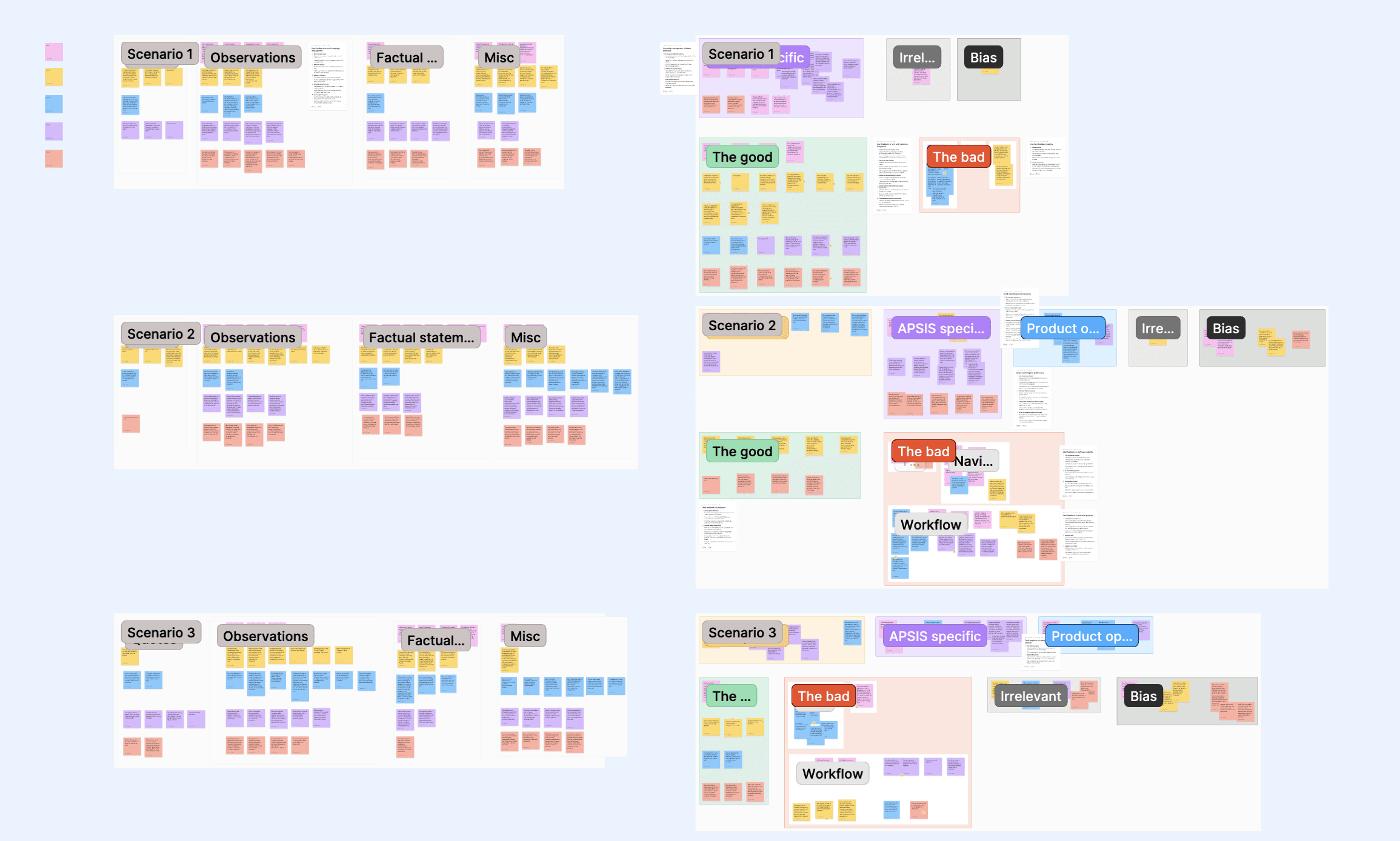
The test was aimed at Marketing specialists with CRM experience, some responsible for implementing tools like ours. Tested varying knowledge levels and usage frequency.


Validated two main CRM flows:

  • Sending email campaign to existing CRM segment

  • Creating email campaign in CRM, then sending within it


Both flows went CRM → MarTech → back. I checked if reports/analytics were useful + discoverable, and if campaign contacts/segments offered right granularity + manageability.


Round 1 findings drove iterations before Round 2 refinement.

The test was aimed at Marketing specialists with CRM experience, some responsible for implementing tools like ours. Tested varying knowledge levels and usage frequency.


Validated two main CRM flows:

  • Sending email campaign to existing CRM segment

  • Creating email campaign in CRM, then sending within it


Both flows went CRM → MarTech → back. I checked if reports/analytics were useful + discoverable, and if campaign contacts/segments offered right granularity + manageability.


Round 1 findings drove iterations before Round 2 refinement.

Round 1

Solution well-received overall. Long-time users adapted despite initial confusion. Terminology alignment proved crucial for clarity/consistency.


Key user preferences:

  • Labels like "Create new email"

  • "Marketing" in CRM menu

  • Intuitive order: Create campaign + contact list before sending


Post-test changes:

  • Terminology: efficy adopted Apsis labels for cross-platform consistency

  • Workflow: Users can now create campaign, plan, set contacts first

  • UI: Simplified empty/draft campaign screens for better clarity/usability

  • Profile view: Added campaign involvement count on contacts page

Solution well-received overall. Long-time users adapted despite initial confusion. Terminology alignment proved crucial for clarity/consistency.


Key user preferences:

  • Labels like "Create new email"

  • "Marketing" in CRM menu

  • Intuitive order: Create campaign + contact list before sending


Post-test changes:

  • Terminology: efficy adopted Apsis labels for cross-platform consistency

  • Workflow: Users can now create campaign, plan, set contacts first

  • UI: Simplified empty/draft campaign screens for better clarity/usability

  • Profile view: Added campaign involvement count on contacts page

Solution well-received overall. Long-time users adapted despite initial confusion. Terminology alignment proved crucial for clarity/consistency.


Key user preferences:

  • Labels like "Create new email"

  • "Marketing" in CRM menu

  • Intuitive order: Create campaign + contact list before sending


Post-test changes:

  • Terminology: efficy adopted Apsis labels for cross-platform consistency

  • Workflow: Users can now create campaign, plan, set contacts first

  • UI: Simplified empty/draft campaign screens for better clarity/usability

  • Profile view: Added campaign involvement count on contacts page

Round 2

Users loved it and the sentiment was positive across the board, praising the user-friendly interface and intuitive design. Previous issues fully resolved.


Main insight: Current integration felt ambiguoussimilar look/feel suggested unity, but separation caused discomfort.


My team presentation highlighted two paths forward:

  • Enhance transitions: Distinct logos + descriptive splash screens for clearer tool-switching

  • Full integration: Single system, unified menu for CRM + marketing


Decision: Full integration aligned with higher-level strategy. MVP compromised with short-term separation while targeting true single-platform future.

Users loved it and the sentiment was positive across the board, praising the user-friendly interface and intuitive design. Previous issues fully resolved.


Main insight: Current integration felt ambiguoussimilar look/feel suggested unity, but separation caused discomfort.


My team presentation highlighted two paths forward:

  • Enhance transitions: Distinct logos + descriptive splash screens for clearer tool-switching

  • Full integration: Single system, unified menu for CRM + marketing


Decision: Full integration aligned with higher-level strategy. MVP compromised with short-term separation while targeting true single-platform future.

Solution

A seamless, easy to set up CRM x MarTech solution

A seamless, easy to set up CRM x MarTech solution

An integration that enables users to send emails directly from the CRM platform, utilise MarTech to customise their emails, and return to the CRM for seamless overview and management without interruptions.

An integration that enables users to send emails directly from the CRM platform, utilise MarTech to customise their emails, and return to the CRM for seamless overview and management without interruptions.

Flexible and intuitive tool for personalised, data-driven campaigns

Flexible and intuitive tool for personalised, data-driven campaigns

Users can begin with a pre-existing segment of people or by creating a campaign in the CRM. If the recipient is a segment, users can utilise data from either platform to add data tags and personalise their email sending.

Users can begin with a pre-existing segment of people or by creating a campaign in the CRM. If the recipient is a segment, users can utilise data from either platform to add data tags and personalise their email sending.

Unified analytics and key metrics at a glance

Unified analytics and key metrics at a glance

Track key metrics like open rates and click-through rates with clear, straightforward visual reports that are easy to interpret. Users can quickly access a condensed view in the CRM or a more detailed report in MarTech.

Track key metrics like open rates and click-through rates with clear, straightforward visual reports that are easy to interpret. Users can quickly access a condensed view in the CRM or a more detailed report in MarTech.

Key takeaways

Iteration power

Hundreds of revisions transformed the prototype from good to exceptional. Pre-testing colleague feedbackdesigners and non-designers alike—forced detachment, letting me see the work objectively instead of defensively.

Stakeholder navigation

Technical constraints were tough, but political challenges proved equally demanding. Input from PMs, executives, and marketers enriched the outcome, though balancing voices required navigating complex negotiation across product lines.

Strategic compromise

Suboptimal usability decisions were hard pills to swallow, but necessary for alignment and harmony. This incredibly complex project taught that compromise unlocks MVP progress—perfection serves no one if it stalls shipping.